
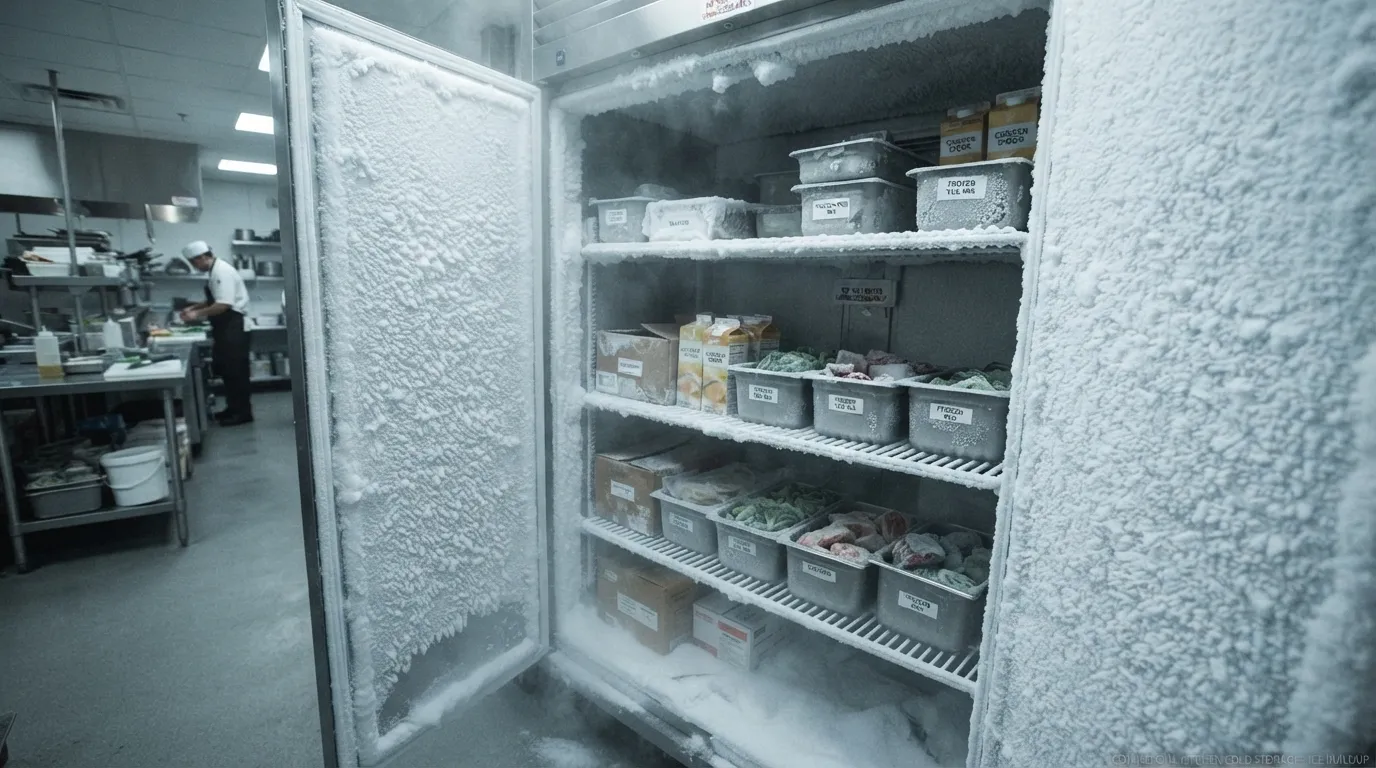
 Frost is normal in low-temperature refrigeration. The problem begins when ice accumulates faster than the equipment can remove it, or when frost starts affecting airflow, heat transfer, door sealing, or usable storage space.
For commercial refrigeration operators, excessive frost is usually a symptom rather than the root problem. The cause may be as simple as a freezer door being left open too often. It may also point to a damaged door gasket, high ambient humidity, a blocked drain, or a defrost system that is not working correctly.
This distinction matters.
Manually removing the ice may restore the cabinet temporarily, but if the underlying cause remains, the frost will return.
For distributors, importers, and procurement teams, frost prevention also begins with equipment selection. A freezer used in a humid convenience store with frequent door openings faces very different conditions from one installed in a dry, air-conditioned storage room.
Understanding how frost forms and what causes excessive accumulation can help operators troubleshoot problems more effectively and help buyers select equipment that is better suited to its intended application.
Why Frost Prevention Matters for Commercial Operations
 A small amount of frost is not necessarily a sign of equipment failure. Excessive frost, however, can affect refrigeration performance and daily operation in several ways.
Frost will cause higher energy costs
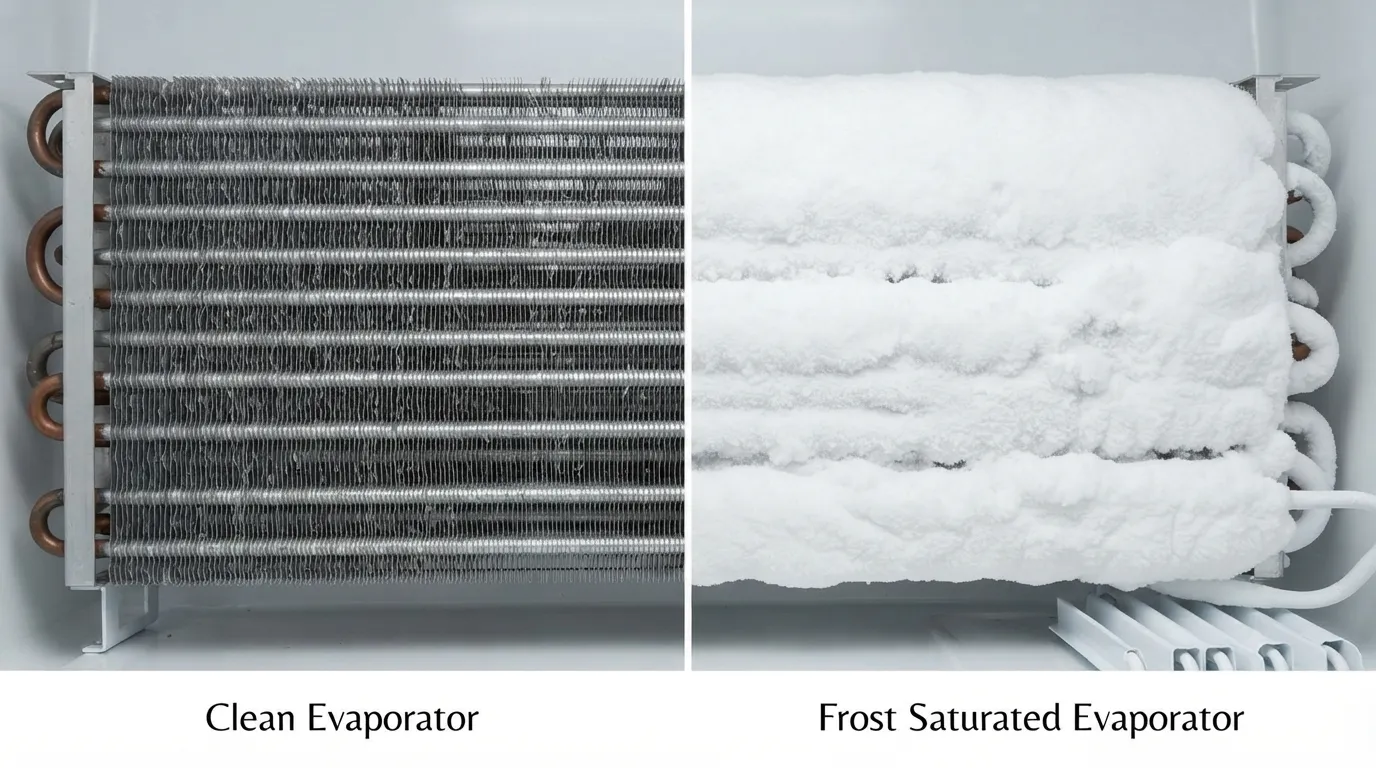
The evaporator is responsible for absorbing heat from inside the refrigerated cabinet. When a thick layer of ice forms on the evaporator surface, it creates an insulating barrier between the cold surface and the air that needs to be cooled.
In fan-assisted and dynamic refrigeration systems, heavy frost can also restrict airflow through the evaporator. As airflow decreases, the cabinet may have more difficulty maintaining the required temperature.
The practical principle is simpler: an evaporator covered with excessive ice generally cannot transfer heat as effectively as a clean evaporator.
Frost can affect temperature stability
Commercial refrigerators and freezers need to maintain appropriate temperatures for the products they store.
A refrigerator operating around 2–8°C normally faces a different frost risk from a freezer operating at approximately -18°C to -22°C. In a freezer, moisture entering the cabinet can quickly freeze on cold surfaces.
When frost becomes excessive, it may restrict airflow or interfere with the normal operation of the refrigeration system. In dynamic-cooling equipment, this can contribute to uneven temperature distribution. In direct-cooling equipment, ice accumulation on cold surfaces can also change heat transfer inside the cabinet.
The actual operating temperature should always follow the equipment specification and the requirements of the stored products.
Frost can reduce usable storage space
In a busy commercial freezer, accumulated ice takes up space that could otherwise be used for products.
Ice may form around shelves, baskets, evaporators, or internal walls. In severe cases, products can become difficult to access, drawers may not operate correctly, and doors may be affected by ice buildup.
Frost can increase refrigeration workload
A heavily iced evaporator may have reduced heat-transfer and airflow performance. If the cabinet struggles to reach or maintain its target temperature, the refrigeration system may need to operate for longer periods.
Frost and defrost frequency are connected
Defrost systems remove accumulated ice from cold surfaces.
If defrost occurs too infrequently, frost can gradually build up until it affects performance. If defrost occurs too frequently or runs longer than necessary, it may introduce unnecessary energy use or temperature fluctuations.
The correct defrost strategy depends on the equipment and application. A refrigerator, a low-temperature freezer, and a frequently opened retail freezer may all require different approaches.
How Frost Forms in Commercial Refrigerators and Freezers
Frost forms when moisture from the surrounding air reaches a surface that is cold enough for the moisture to freeze.
The process is particularly easy to observe in commercial freezers.
When a freezer door opens, relatively warm and humid room air enters the cabinet. The moisture contained in that air eventually reaches cold surfaces, such as the evaporator, and freezes.
If the door is opened repeatedly, more moisture enters. Over time, the frost layer becomes thicker.
This is why frost formation is not automatically evidence of a defective compressor or refrigerant system.
Relative humidity plays an important role
The amount of moisture carried by incoming air depends partly on the surrounding temperature and relative humidity.
In a humid environment, each door opening can introduce more moisture into a freezer than the same door opening in a dry environment.
This is one reason frost management can be more challenging in tropical and coastal markets.
A freezer installed in a humid restaurant kitchen and opened dozens of times a day may accumulate frost much faster than an identical freezer located in a dry, controlled warehouse.
Door openings introduce moisture
Every time a freezer door opens, some of the cold cabinet air escapes and surrounding air enters.
The longer the door remains open, the greater the exchange.
In a convenience store, customers may open a display freezer repeatedly throughout the day. In a restaurant, employees may open a storage freezer several times while preparing food.
The practical response is not to eliminate all door openings, which is impossible, but to minimize unnecessary opening time and organize products so that staff can find what they need quickly.
Door gasket leakage can create continuous moisture entry
Normal door opening is intermittent. A leaking gasket can allow warm, humid air to enter continuously.
This is why a damaged gasket can create a persistent frost problem even when operators are using the freezer correctly.
A freezer with a poor seal may also show frost or condensation around the door perimeter.
Evaporator temperature affects frost formation
Frost tends to form on surfaces below freezing.
The evaporator is often one of the coldest surfaces inside a commercial freezer, making it a natural location for frost accumulation.
The pattern of frost can sometimes provide useful clues during troubleshooting. A qualified technician may need to check evaporator temperature, airflow, fan operation, sensors, defrost controls, and the refrigerant system before identifying the root cause.
4 Common Causes of Excessive Frost and How to Fix Them
1. Door Seal and Gasket Problems
The door gasket is one of the first components to inspect when a commercial freezer develops excessive frost.
A properly fitted gasket creates a seal between the door and cabinet. If the gasket is damaged, deformed, incorrectly installed, or contaminated with debris, warm humid air can enter the cabinet.
Common signs of a gasket problem
Look for:
Frost concentrated around the door opening
Ice forming near the gasket
Condensation around the door frame
Visible cracks or tears
Flattened or permanently deformed sections
A door that does not close completely
A gasket that has pulled away from the door
Operators can start with a simple visual inspection.
Make sure the gasket contacts the cabinet frame evenly when the door is closed. Check for gaps around the perimeter and remove any food residue or dirt that may prevent proper sealing.
A basic paper test can also help identify weak areas. Close the door on a sheet of paper and gently pull it. If the paper slides out very easily at one location while the seal is stronger elsewhere, that area may need further inspection.
This is only a basic field check. It does not replace professional diagnosis.
If the gasket is torn, cracked, or permanently deformed, replacement is usually the appropriate solution.
For distributors and importers, gasket design is therefore worth considering during equipment selection. Magnetic sealing performance, gasket profile, door alignment, and cabinet frame construction all contribute to the quality of the seal.
2. High Ambient Humidity
High humidity increases the moisture load entering refrigeration equipment.
This can become particularly noticeable in tropical and coastal markets, where warm and humid air may enter the cabinet every time a door is opened.
Consider a convenience store freezer located near the entrance of a busy shop. The freezer may be opened repeatedly by customers while the surrounding air remains warm and humid.
Under these conditions, frost accumulation may occur faster than it would in a dry, air-conditioned environment.
This does not necessarily indicate that the refrigeration system is defective.
Select equipment for the actual environment
When choosing commercial refrigeration equipment, buyers should consider more than the target cabinet temperature.
Important questions include:
What is the expected ambient temperature?
Is the installation location air-conditioned?
Is the climate humid or dry?
How frequently will the door be opened?
Is the equipment used for retail display or back-of-house storage?
Is the equipment installed indoors or in a semi-open environment?
A freezer designed for a controlled indoor supermarket may not be the right choice for a poorly ventilated storage area with high ambient temperatures.
For international distributors, understanding the destination market is particularly important. Equipment specifications should match the real operating environment rather than being selected solely by internal temperature and cabinet dimensions.
3. Defrost System Problems
The defrost system is designed to remove ice from the evaporator before frost starts affecting cooling performance.
If excessive frost builds up again shortly after manual defrosting, the defrost system should be one of the first areas to check.
Common defrost-related problems include:
- Defrost heater failure
- Faulty temperature sensors
- Timer or controller failure
- Incorrect defrost settings
- Insufficient defrost frequency
- Defrost cycle ending too early
- Blocked condensate drain
The exact cause depends on the refrigeration system design and operating conditions.
Electric defrost
Electric defrost uses heating elements to melt ice from the evaporator.
It is widely used in low-temperature freezers and applications where natural defrosting is not sufficient.
If the heating elements fail, ice can gradually build up on the evaporator, reducing airflow and heat-transfer efficiency.
Off-cycle defrost
Off-cycle defrost removes frost by stopping the refrigeration cycle and allowing the evaporator temperature to rise naturally.
This method is commonly used in higher-temperature refrigeration applications where frost accumulation is limited.
It is usually not suitable for low-temperature freezers because the evaporator remains below freezing for long periods.
Hot gas defrost
Hot gas defrost uses heat from the refrigeration system to remove ice from the evaporator.
It is commonly found in larger commercial refrigeration systems and low-temperature applications where frequent defrosting is required.
If the hot gas valve, control components, or defrost sequence fails, ice can continue building up and reduce system performance.
Drainage problems
Defrosting melts the ice, but the water produced must drain away properly.
A blocked or poorly designed drain can cause water to collect and freeze again, creating a repeated ice buildup problem even when the defrost system is working correctly.
For this reason, drainage should always be checked when investigating recurring frost problems.
When professional diagnosis is needed
If frost returns quickly after a complete defrost cycle, a refrigeration technician may need to inspect:
- Defrost heater or hot gas valve operation
- Defrost controller and settings
- Defrost termination sensor
- Evaporator fan operation
- Drainage system
- Evaporator temperature
- Overall refrigeration system performance
Simply resetting the controller or replacing a single component may not solve the problem if the actual cause is related to airflow, drainage, or refrigeration system conditions.
4. Operational Issues
Daily operating practices can significantly influence frost formation.
Leaving doors open
A freezer door left open for several minutes allows warm, humid air to enter continuously.
Staff should be trained to retrieve products efficiently and close doors immediately.
Frequent unnecessary door openings
Repeated short openings also increase moisture entry.
In restaurants, better product organization can reduce the number of times staff need to open a freezer.
Clearly labeled shelves and logical product placement are simple but effective operational improvements.
Loading warm products
Warm products add heat to the cabinet and increase the refrigeration load.
Where the application requires pre-chilling or pre-freezing, products should be handled according to appropriate food safety procedures and the equipment manufacturer’s recommendations.
A storage freezer should not automatically be treated as a blast freezer.
Overloading the cabinet
Overloading can restrict airflow, particularly in fan-assisted systems.
Products should not block evaporator air outlets, return-air passages, or other designed airflow paths.
Even when the refrigeration system is operating correctly, poor loading can contribute to uneven temperatures and localized ice accumulation.
Door alarms
Door-open alarms can be useful in retail and foodservice applications.
They do not prevent frost directly, but they can alert staff when a door remains open longer than expected.
Night curtains for suitable display applications
Night curtains can be useful for certain open-display refrigeration systems outside business hours.
They may reduce exposure to surrounding room air, but they must be compatible with the cabinet’s airflow design and operating requirements.
They should not be installed in a way that blocks required airflow.
Preventing Frost Through Better Equipment Selection
Frost prevention starts before equipment is installed.
For distributors and procurement managers, selecting a commercial freezer based only on cabinet temperature and external dimensions may overlook important factors.
The cooling method, defrost strategy, ambient conditions, door usage, drainage, and maintenance requirements should all be considered.
Direct Cooling vs. Dynamic Cooling
Direct cooling relies primarily on natural air movement and cold surfaces to transfer heat.
Dynamic or forced-air systems actively circulate air through the cabinet and across the evaporator.
Neither system is automatically better for every application.
Direct cooling may be suitable for products and applications where gentle cooling and limited air movement are desirable.
Fan-assisted cooling can provide more active air circulation and temperature distribution, but airflow becomes an important part of frost management. If the evaporator becomes heavily iced, air circulation can be restricted.
The right choice depends on the products, required temperature uniformity, cabinet design, and operating environment.
For a detailed comparison, see:
Direct Cooling vs Dynamic Cooling: Which System Is Better
Automatic Defrost vs. Manual Defrost
Automatic defrost reduces the need for operators to manually remove accumulated frost.
Depending on the equipment, automatic defrost may use electric heaters, off-cycle defrost, or other control strategies.
Manual defrost equipment requires the operator to periodically remove accumulated ice.
The correct choice depends on:
- Equipment type
- Operating temperature
- Door-opening frequency
- Ambient humidity
- Maintenance resources
- Product requirements
An automatic-defrost system is not necessarily more energy efficient in every application. Its main advantage may instead be reduced manual intervention and more consistent frost management.
Buyers should confirm the actual defrost method rather than relying only on terms such as “automatic defrost” or “no-frost,” which may be used differently by different manufacturers.
For more detail, see:
Defrosting Methods in Commercial Refrigerators and Freezers
Key Features to Consider When Ordering Commercial Refrigeration Equipment
The following features may help reduce frost-related problems when properly matched to the application.
Magnetic door gaskets
A well-designed gasket should maintain reliable contact around the complete door perimeter.
For distributors, it is also worth considering whether replacement gaskets are readily available and easy to replace during maintenance.
Heated door frames
Heated door frames can help reduce condensation and ice formation around freezer door openings in certain applications.
They should be evaluated together with the equipment’s operating environment and energy requirements.
Automatic defrost systems
Automatic defrost can reduce manual frost removal.
The buyer should confirm the specific defrost method, control logic, and expected maintenance requirements.
Defrost controllers and sensors
Reliable controllers and properly positioned sensors are important for managing defrost cycles.
The system should be configured according to the equipment design and operating conditions.
Door-open alarms
Useful for high-traffic retail and foodservice applications where doors are frequently accessed.
Suitable insulation
Good insulation reduces heat transfer between the cabinet interior and surrounding environment.
However, insulation cannot compensate for a poor door seal, excessive door openings, or unsuitable ambient conditions.
Proper drainage
Defrost water needs a reliable path away from the evaporator and cabinet.
Drainage should be considered during both equipment selection and installation.
Appropriate ambient temperature rating
The equipment’s ambient rating is particularly important for international markets.
A freezer designed to maintain a low internal temperature still has to reject heat to the surrounding environment.
For distributors, the expected installation conditions should be communicated to the manufacturer before equipment selection.
Practical Maintenance Checklist
Regular maintenance can help identify frost-related problems before they affect daily operation.
| Frequency | What to Check | Who Should Do It |
|---|---|---|
| Daily | Cabinet temperature, abnormal frost, door closing | Operator |
| Monthly | Door gasket, air leakage, drain openings, ice accumulation | Operator |
| Quarterly | Defrost performance, airflow, fans, temperature stability | Operator / Technician |
| Annually | Refrigeration system, electrical components, condenser, controls | Qualified Technician |
Daily checks
Confirm cabinet temperature is within the required range.
Look for unusual or rapidly increasing frost.
Make sure doors close completely.
Avoid unnecessary door opening.
Check that products are not blocking airflow.
Monthly checks
Inspect door gaskets for cracks or deformation.
Check for possible air leakage.
Clean the gasket and sealing surfaces.
Inspect drain openings.
Look for abnormal ice accumulation.
Quarterly checks
Depending on the equipment and manufacturer’s recommendations:
Review defrost performance.
Check temperature stability.
Inspect fans and airflow.
Check condensate drainage.
Investigate unusual changes in operating noise or run time.
Annual professional inspection
A qualified technician may inspect:
Refrigeration system performance
Electrical components
Condenser condition
Fans and motors
Temperature sensors and controls
Defrost system
Refrigerant system where appropriate
Operators should not attempt sealed-system refrigeration repairs, refrigerant charging, or electrical work unless they have the required qualifications.
What Should Distributors Check When Selecting Commercial Freezers?
For distributors and importers, frost prevention should be considered as part of the overall equipment selection process.
Before recommending a model, consider:
Ambient temperature — What temperatures will the equipment actually face?
Humidity — Is the equipment going into a tropical, coastal, or humid market?
Door usage — How frequently will customers or staff open the cabinet?
Installation environment — Is it air-conditioned, ventilated, or semi-open?
Required temperature — Is the equipment for chilled or frozen products?
Cooling method — Is direct or dynamic cooling more appropriate?
Defrost method — Is manual, off-cycle, electric, or another defrost strategy suitable?
Drainage — How will defrost water be removed?
Maintenance — Are replacement gaskets and components readily available?
Technical support — Can local technicians service the refrigeration and control systems?
The same freezer model may perform differently in two markets because the operating conditions are different.
For international B2B buyers, specifying the application correctly before placing an order can prevent many problems later.
FAQ
Why does my commercial freezer have excessive frost?
Common causes include frequent door openings, high ambient humidity, damaged door gaskets, blocked airflow, defrost system problems, and drainage issues.
The first step is to determine whether frost is entering primarily through normal moisture exchange or whether a technical fault is preventing proper defrosting.
How can I prevent frost buildup in a commercial freezer?
Keep doors closed as much as possible, maintain good gasket sealing, avoid blocking airflow, use the correct defrost strategy, and select equipment suitable for the ambient operating conditions.
If frost continues to accumulate rapidly, the defrost system and refrigeration system should be inspected.
What causes frost around a commercial freezer door?
Possible causes include a damaged or poorly fitted gasket, door misalignment, excessive humidity, or a door that is not closing completely.
Check the gasket and door alignment first. If the problem persists, professional inspection may be required.
Is a no-frost commercial freezer always more energy efficient?
No.
Energy consumption depends on the complete refrigeration system, including the compressor, insulation, ambient temperature, door usage, controls, and defrost method.
Automatic or no-frost operation can reduce manual maintenance, but it does not automatically guarantee lower energy consumption.
What type of commercial freezer is better for humid climates?
The best choice depends on the application.
For humid climates, buyers should pay attention to ambient temperature ratings, door gasket design, defrost strategy, drainage, insulation, and the expected frequency of door openings.
The equipment should be selected for the actual installation environment rather than only the required internal temperature.
How often should a commercial freezer be defrosted?
There is no universal interval.
Automatic-defrost equipment follows its programmed or controlled defrost strategy. Manual-defrost equipment should be defrosted when ice accumulation begins to affect storage capacity, airflow, door operation, or refrigeration performance.
The manufacturer’s recommendations should be followed for each specific model.
Can commercial refrigeration equipment be customized for high-humidity environments?
Depending on the manufacturer and equipment type, different configurations may be available for specific operating conditions.
Potential considerations may include refrigeration capacity, door construction, gasket design, defrost controls, drainage, and other components.
The available options depend on the model, manufacturer, destination market, and project requirements.
Final Takeaway
Excessive frost is not always a sign of a failed refrigeration system.
In many cases, the underlying cause is related to moisture entering the cabinet through frequent door openings, high ambient humidity, or a poor door seal. In other cases, the problem may involve the defrost system, drainage, airflow, or another technical issue.
For operators, the most useful approach is to identify the cause rather than repeatedly removing the ice.
For distributors and procurement teams, frost prevention begins with selecting equipment that matches the application. Ambient conditions, humidity, door-opening frequency, cooling method, defrost strategy, drainage, and maintenance requirements should all be considered.
A commercial refrigerator or freezer performs best when the equipment design and operating environment are properly matched.