

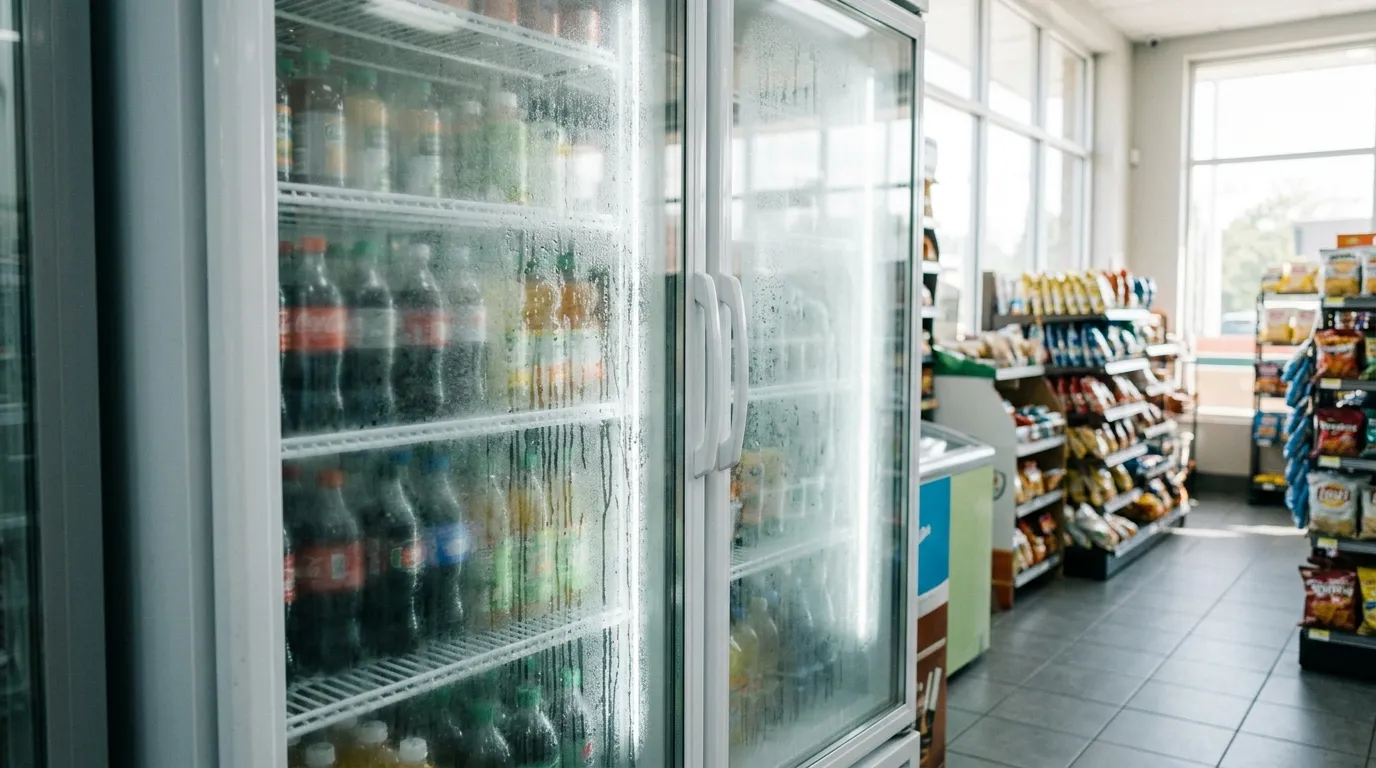
 Condensation on commercial refrigerator glass doors is a common problem in supermarkets, convenience stores, restaurants, and other retail environments—especially in hot and humid climates. Water droplets, fogging, or “sweating” glass can reduce product visibility, affect the appearance of a display, and create concerns about refrigeration performance.
For distributors, however, condensation should not be viewed simply as an operating problem. Persistent glass condensation can also indicate that the refrigerator has been selected incorrectly for its climate, installed in unsuitable conditions, or built with inadequate door and cabinet insulation.
This guide explains the technical causes of commercial refrigerator glass door condensation, how operators can reduce it, and what importers and distributors should check when sourcing glass door coolers for humid or tropical markets.
Understanding Condensation on Commercial Glass Door Refrigerators
Is Condensation Normal or a Sign of Poor Equipment Performance?
A small amount of condensation can be normal under certain environmental conditions. It does not automatically mean that the refrigerator is defective.
The key factor is the relationship between the surface temperature of the glass and the surrounding air’s dew point.
When warm, humid air contacts a sufficiently cold glass surface, moisture in the air changes from vapor into liquid water. This produces the familiar droplets or fogging commonly called glass door sweating.
For example, a glass door operating in a store with 30°C air temperature and 75% relative humidity can experience condensation much more easily than the same refrigerator operating in a dry 20°C environment.
Therefore, a manufacturer should evaluate condensation together with:
- Ambient temperature
- Relative humidity
- Dew point
- Glass surface temperature
- Door construction
- Door frame temperature
- Door gasket condition
- Refrigerator installation conditions
A refrigerator designed for a dry, moderate climate may perform normally in its intended environment but experience significant external condensation when installed in a tropical market.
For commercial buyers, the important question is therefore not simply “Does the glass sweat?” but “Under what ambient conditions is the refrigerator designed to operate without excessive condensation?”
External Glass Condensation vs. Internal Frost: Understanding the Difference
External condensation and internal frost are different problems and usually have different causes.
External glass condensation occurs on the outside surface of the door. It is primarily related to ambient humidity, dew point, glass temperature, door construction, and airflow.
Internal frost occurs inside the refrigerated space or on internal surfaces. It can be associated with:
- Frequent door opening
- Warm or humid air entering the cabinet
- Damaged door gaskets
- Poor door closing
- Incorrect defrost settings
- Refrigeration system problems
- Excessive product loading or airflow restriction
This distinction is important when troubleshooting a commercial refrigerator.
If water droplets appear mainly on the outside of the glass, improving the glass thermal performance may be more important than changing the refrigeration capacity.
If frost is accumulating inside the cabinet, the problem may instead involve infiltration, defrost, sealing, or refrigeration-system operation.
How Temperature, Humidity, and Dew Point Create Glass Fogging
The easiest way to understand condensation is to think about dew point.
Air can hold a certain amount of water vapor. Warm air can hold more moisture than cold air. When humid air contacts a surface whose temperature is below the air’s dew point, condensation begins.
This means that two identical commercial glass door refrigerators can behave differently in two countries.
A cooler installed in a dry inland market may have little external condensation, while the same model installed in a coastal tropical city may develop substantial moisture on the glass.
This is why commercial refrigeration manufacturers need to consider ambient temperature and humidity together, rather than specifying performance based only on room temperature.
Why Commercial Glass Door Refrigerators Develop Condensation
High Ambient Humidity and Tropical Climate Conditions
High humidity is one of the most common causes of external condensation.
In tropical and subtropical markets, ambient conditions can remain hot and humid for long periods. Supermarkets and convenience stores may also have doors opening frequently, allowing additional humid air into the sales area.
In these environments, standard unheated glass may not always provide sufficient resistance to external condensation.
For distributors selling into Southeast Asia, the Middle East, Latin America, Africa, or other challenging climates, it is important to request the manufacturer’s intended ambient operating conditions before selecting a model.
Frequent Door Opening and High Customer Traffic
Every time a refrigerator door opens, warm ambient air can enter the cabinet while cold air escapes.
High-traffic retail applications are particularly demanding. A beverage cooler near a supermarket entrance, for example, may experience hundreds of door openings during a busy day.
Frequent opening affects internal temperature stability and increases the amount of moisture entering the cabinet.
For operators, practical measures include:
- Keep doors closed when the refrigerator is not being accessed.
- Avoid leaving doors partially open.
- Check automatic door-closing mechanisms.
- Avoid overloading shelves.
- Keep products away from the door area.
- Replace damaged gaskets promptly.
For distributors, high-door-opening applications should be considered when recommending equipment rather than treating all retail refrigeration applications as equivalent.
Poor Store Ventilation and Airflow Problems
Air movement around the refrigerator can also influence condensation.
A refrigerator placed in an area with poor ventilation may experience abnormal heat accumulation around the cabinet and refrigeration system.
Conversely, strong warm airflow directed toward the glass can increase the temperature and humidity of the air contacting the door.
Air-conditioning outlets, entrance doors, ceiling fans, and other equipment should therefore be considered when determining the installation position.
Heat Sources Near Refrigeration Equipment
Commercial refrigerators should not be installed immediately beside significant heat sources.
Potential sources include:
- Ovens
- Fryers
- Cooking equipment
- Direct sunlight
- Heating equipment
- Large air-conditioning exhausts
These sources increase the local ambient temperature and can increase the thermal load on the refrigerator.
For glass door coolers, direct sunlight can be particularly problematic because solar radiation can heat the glass surface and increase the refrigeration load.
Main Equipment Factors That Cause Glass Door Condensation
Glass Door Technology: Double Glass, Low-E Coating, and Heated Glass
Glass construction has a major effect on condensation performance.
Double-glazed glass provides better thermal insulation than single glass because the air or gas layer between the panes reduces heat transfer.
Low-E glass uses a low-emissivity coating to reduce radiant heat transfer. It can improve thermal performance while helping reduce the energy required to maintain cabinet temperature .
Heated glass uses an electrical heating element to maintain the external glass surface above the local condensation point.
For humid environments, heated glass can provide a much more reliable anti-condensation solution, particularly where high humidity and frequent door opening occur.
However, heated glass also consumes additional electricity. Buyers should therefore evaluate the application and climate rather than automatically selecting the highest-cost glass option.
Door Gaskets, Seals, Frames, and Thermal Bridging Issues
The glass itself is not the only part of the door that matters.
Door frames, gaskets, spacers, hinges, and other components can create thermal bridges. If the frame or surrounding surface becomes sufficiently cold, condensation may occur even when the central glass area remains relatively clear.
A properly designed door should therefore consider the complete thermal path rather than simply specifying double glass.
Door gaskets are equally important. A damaged or poorly fitted gasket can allow warm, humid air to enter the cabinet and contribute to internal frosting and temperature instability.
Insulation Thickness and Cabinet Construction Quality
Cabinet insulation reduces heat transfer between the refrigerated interior and the surrounding environment.
For many commercial upright refrigerators and glass door coolers, polyurethane foam insulation is used because of its relatively low thermal conductivity.
The actual performance depends on more than nominal insulation thickness. Manufacturers should also consider:
- Insulation density
- Foaming quality
- Cabinet structure
- Door insulation
- Thermal bridges
- Panel joints
- Door-frame construction
A thicker cabinet does not automatically mean a better refrigerator if other parts of the thermal design are inadequate.
Cooling System Design: Direct Cooling vs. Dynamic Cooling
Commercial refrigerators can use different air and heat-transfer configurations.
Direct cooling systems generally cool through the evaporator and cabinet surfaces without continuously circulating large volumes of cold air.
Dynamic cooling, or fan-forced cooling, uses fans to circulate refrigerated air throughout the cabinet.
Dynamic cooling can provide more uniform temperature distribution and is widely used in display refrigerators(eg, meat & deli display cases , cake display cases ) where consistent product temperature is important.
However, cooling-system selection should be based on the application, product type, cabinet design, and required temperature range—not simply whether condensation is occurring on the glass.
How to Reduce Condensation on Existing Commercial Refrigerators
Improve Store Humidity Control and Airflow
The first step is to evaluate the store environment.
Where possible:
- Reduce excessive indoor humidity.
- Keep external doors closed.
- Prevent humid outdoor air from entering continuously.
- Avoid placing refrigerators directly under air-conditioning outlets.
- Maintain sufficient airflow around the condenser.
- Avoid direct sunlight.
In very humid environments, environmental control may be necessary even when the refrigerator itself is functioning correctly.
Optimize Door Usage, Product Loading, and Operating Practices
Operators should avoid unnecessarily long door-opening periods.
Products should be loaded without blocking internal air circulation. Overloading can restrict airflow and cause uneven temperatures.
For glass door coolers in supermarkets and convenience stores, correct product loading is particularly important because operators often try to maximize display capacity.
Maintain Condenser, Fans, and Air Circulation Components
A dirty condenser reduces heat rejection and can increase refrigeration-system operating temperatures.
Routine maintenance should include:
- Cleaning the condenser
- Checking condenser fans
- Inspecting evaporator fans
- Checking airflow
- Inspecting electrical connections
- Checking defrost operation
- Monitoring cabinet temperature
Maintenance schedules should be adapted to the operating environment. Refrigerators installed in dusty commercial kitchens may require more frequent cleaning than equipment installed in a clean supermarket.
Inspect Door Gaskets and Replace Damaged Seals
A gasket that has become cracked, deformed, or loose can allow warm air into the refrigerated compartment.
Check that:
- The gasket contacts the frame evenly.
- The door closes completely.
- There are no visible gaps.
- Hinges are correctly adjusted.
- The gasket has not become brittle.
This is a relatively simple maintenance item but can have a significant effect on refrigeration performance.
Adjust Cabinet Location and Installation Conditions
Sometimes the most effective solution is to change the refrigerator’s location.
Avoid placing a glass door cooler:
- In direct sunlight
- Beside ovens or fryers
- Immediately beside frequently opened exterior doors
- In areas with unusually high humidity
- Where airflow from HVAC equipment directly contacts the glass
For new store projects, installation conditions should be considered before purchasing the equipment.
How to Select Commercial Glass Door Refrigerators for Humid Markets
Choosing Between Low-E Glass and Heated Glass Doors
For moderate climates, double-glazed Low-E glass may provide a good balance between thermal performance and energy consumption.
For high-humidity or tropical markets, heated glass may be preferable when maintaining clear product visibility is critical.
A useful purchasing approach is:
| Application | Typical consideration |
|---|---|
| Dry or moderate climate | Double glass / Low-E glass |
| Warm and moderately humid market | Double glass + Low-E |
| Tropical high-humidity market | Heated glass may be preferred |
| High-traffic retail store | Heated glass + strong door sealing |
| Premium supermarket display | High-performance insulated glass |
The exact selection should still be based on the manufacturer’s tested operating conditions.
Selecting the Right Cooling System for Retail Applications
For beverage and packaged food displays, buyers should consider temperature uniformity, recovery after door opening, product type, and expected traffic.
For distributors, it is useful to classify customers by application:
Convenience stores: frequent door opening, high customer traffic, compact installation spaces.
Supermarkets: long operating hours, high product turnover, strong emphasis on display visibility.
Restaurants: lower customer access but potentially higher ambient temperatures, particularly around kitchens.
Wholesale stores: large product loads and potentially longer periods between door openings.
This application-based approach helps avoid recommending the same refrigerator specification to every customer.
Energy Efficiency Considerations: Glass Performance vs Power Consumption
There is a trade-off between condensation resistance and energy consumption.
Heated glass can improve visibility in humid environments, but the heating element consumes electricity.
Low-E glass and improved insulation can reduce heat transfer without continuously heating the glass.
Therefore, buyers should evaluate total operating cost, not just purchase price.
For a distributor, the correct question is:
Which glass specification provides sufficient condensation resistance for my market without adding unnecessary energy consumption?
Recommended Specifications for Tropical and High-Humidity Regions
When sourcing glass door refrigerators for challenging climates, consider requesting:
- Double-glazed glass
- Low-E coating
- Heated glass where necessary
- High-quality magnetic door gaskets
- Adequate cabinet insulation
- Appropriate climate-class performance
- Correctly sized refrigeration systems
- Reliable condenser airflow
- Anti-corrosion treatment where appropriate
- Suitable voltage and frequency
- Temperature performance validated at the target ambient condition
The final specification should be based on actual market conditions rather than simply copying specifications from a different climate.
What Importers and Distributors Should Check Before Sourcing Glass Door Refrigerators
Glass Specifications: Thickness, Coating, Heating System, and Defogging Performance
Do not stop at “double glass” when requesting quotations.
Ask the manufacturer for:
- Glass thickness
- Number of glass layers
- Low-E coating availability
- Tempered glass specification
- Heated glass availability
- Heating power
- Anti-fogging design
- Door-frame construction
For large-volume orders, buyers should request samples or test units where possible, especially when selling into high-humidity markets.
Cooling Specifications: Compressor, Refrigerant, Temperature Range, and Defrost Method
A professional RFQ should cover the entire refrigeration system.
Request information about:
- Compressor brand and model
- Refrigerant
- Evaporator type
- Condenser type
- Cooling method
- Defrost method
- Rated temperature range
- Ambient operating condition
- Electrical power
- Rated voltage and frequency
The compressor alone does not determine refrigerator performance. Evaporator, condenser, fan, controls, insulation, and cabinet design all contribute to the final result.
Customization Requirements: Voltage, Plug, Branding, and Dimensions
Importers should confirm market-specific requirements before production.
Common customization items include:
- Voltage
- Frequency
- Plug type
- Door configuration
- Cabinet dimensions
- Shelving
- Casters or adjustable feet
- Exterior color
- Logo
- Packaging
- Labeling
- Controller language
For distributors, standardizing these specifications across a product range can simplify inventory and after-sales support.
Compliance Documents and Testing Reports
Depending on the destination market, buyers may need documents related to electrical safety, electromagnetic compatibility, refrigerant handling, energy efficiency, or other regulatory requirements.
Ask the manufacturer which certifications and test reports are available for the specific model rather than assuming that a certificate for one product applies to every model.
Warranty, Spare Parts Availability, and Technical Support
A competitive wholesale price is only one part of the sourcing decision.
Distributors should evaluate:
- Warranty period
- Compressor warranty
- Spare-parts availability
- Replacement gasket availability
- Controller availability
- Fan motor availability
- Door and glass replacement
- Technical documentation
- Troubleshooting support
For imported refrigeration equipment, after-sales support can have a major effect on the distributor’s long-term profitability.
Frequently Asked Questions About Commercial Refrigerator Condensation
Is Condensation Normal on Commercial Glass Door Refrigerators?
Some condensation can occur when ambient temperature and humidity are high enough for the glass surface to fall below the local dew point.
However, excessive or persistent condensation should be investigated. The cause may be environmental conditions, glass design, door sealing, installation, or refrigeration-system operation.
Do Heated Glass Doors Increase Energy Consumption?
Yes. Heated glass uses electrical power to keep the glass surface warm enough to reduce external condensation.
However, in high-humidity markets, the additional energy consumption may be justified if clear product visibility is essential.
The better approach is to compare the additional energy cost with the commercial benefit of maintaining a clear display.
Which Is Better for Humid Areas: Low-E Glass or Heated Glass?
There is no universal answer.
Low-E glass can provide excellent thermal performance and lower heat transfer. Heated glass actively raises the glass surface temperature and can provide stronger condensation resistance in demanding environments.
For tropical, high-humidity, or high-traffic applications, heated glass may be the safer choice. For less demanding climates, Low-E double glazing may offer a better balance of performance and energy consumption.
Why Does My Glass Door Refrigerator Fog Up After Installation?
Possible causes include:
- High indoor humidity
- High ambient temperature
- Insufficient glass thermal performance
- Incorrect installation location
- Direct airflow from HVAC systems
- Door gasket problems
- Door alignment problems
- Excessive door opening
If the problem appears immediately after installation, first compare the actual site conditions with the manufacturer’s rated ambient conditions.
What Specifications Should Distributors Request From Manufacturers?
At minimum, request:
- Glass construction and thickness
- Low-E or heated glass options
- Ambient temperature and humidity test conditions
- Climate class
- Compressor model
- Refrigerant
- Cooling and defrost methods
- Rated temperature range
- Power consumption
- Electrical specifications
- Available certifications
- Warranty and spare-parts policy
A complete technical specification allows distributors to compare manufacturers on actual performance rather than simply comparing FOB prices.
Final Buying Considerations
Commercial refrigerator glass door condensation is not caused by one component alone. It is the result of the interaction between ambient conditions, humidity, dew point, glass construction, door sealing, cabinet insulation, refrigeration-system design, and installation conditions.
For operators, the first step is to determine whether the problem is caused primarily by the store environment or by the equipment.
For importers and distributors, the more important step is to select equipment according to the conditions in the target market.
If you sell commercial refrigeration equipment in tropical or high-humidity regions, do not simply ask a manufacturer for the cheapest glass door cooler. Ask for the glass specification, climate-class performance, operating conditions, refrigeration-system configuration, energy consumption, and available anti-condensation options.
The right specification can reduce customer complaints, improve product visibility, protect your reputation as a distributor, and reduce the total cost of ownership for your customers.