
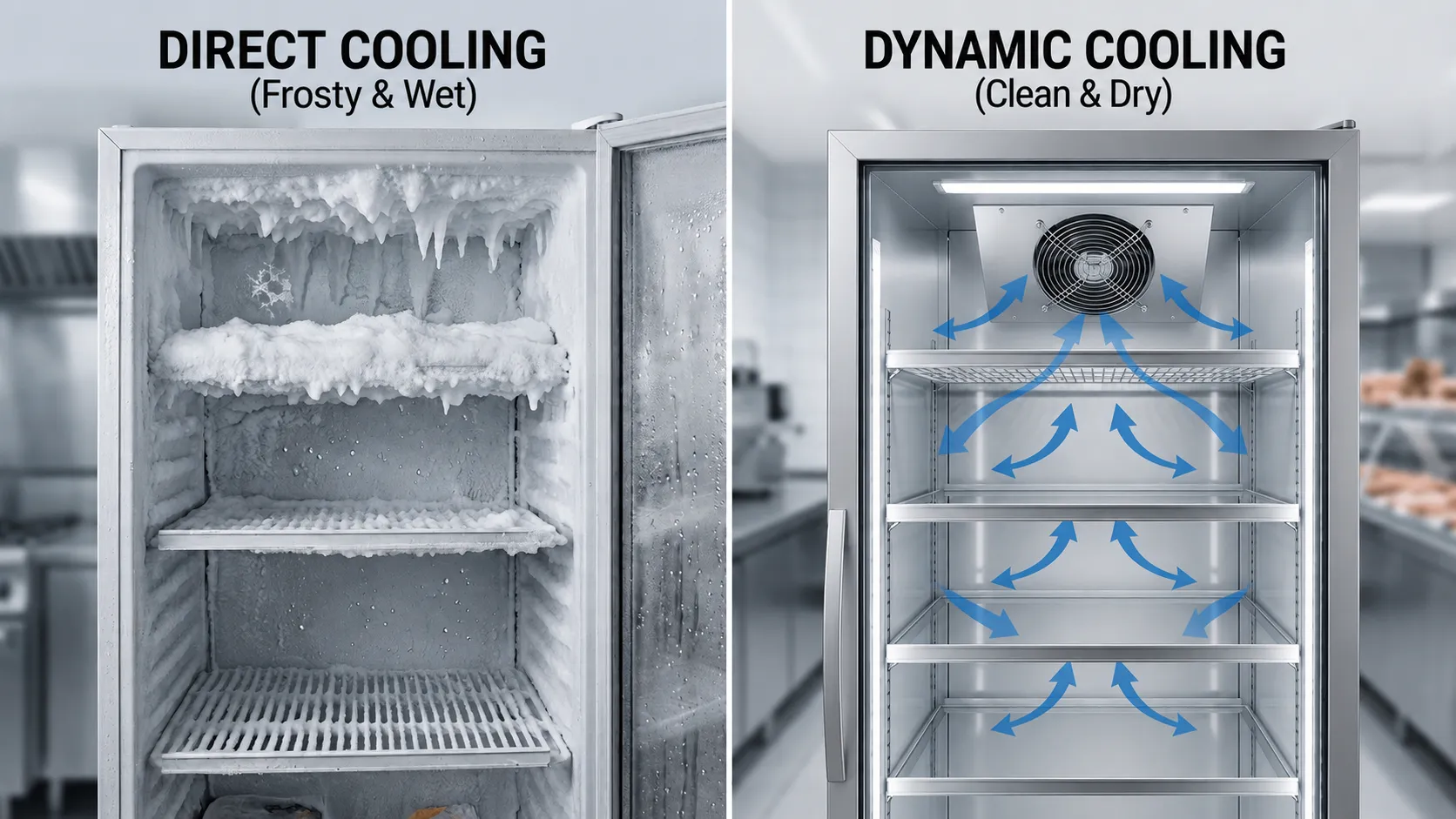
Commercial refrigerators and freezers generally uses one of three cooling system: direct cooling, dynamic cooling, and fan-assisted cooling. Although these terms are sometimes used interchangeably in different markets, they describe different ways of distributing cold air inside the cabinet.
Understanding how each system works makes it easier to choose equipment that matches the products you sell and the environment where the cabinet will operate.
What Is Direct Cooling (Static Cooling)?
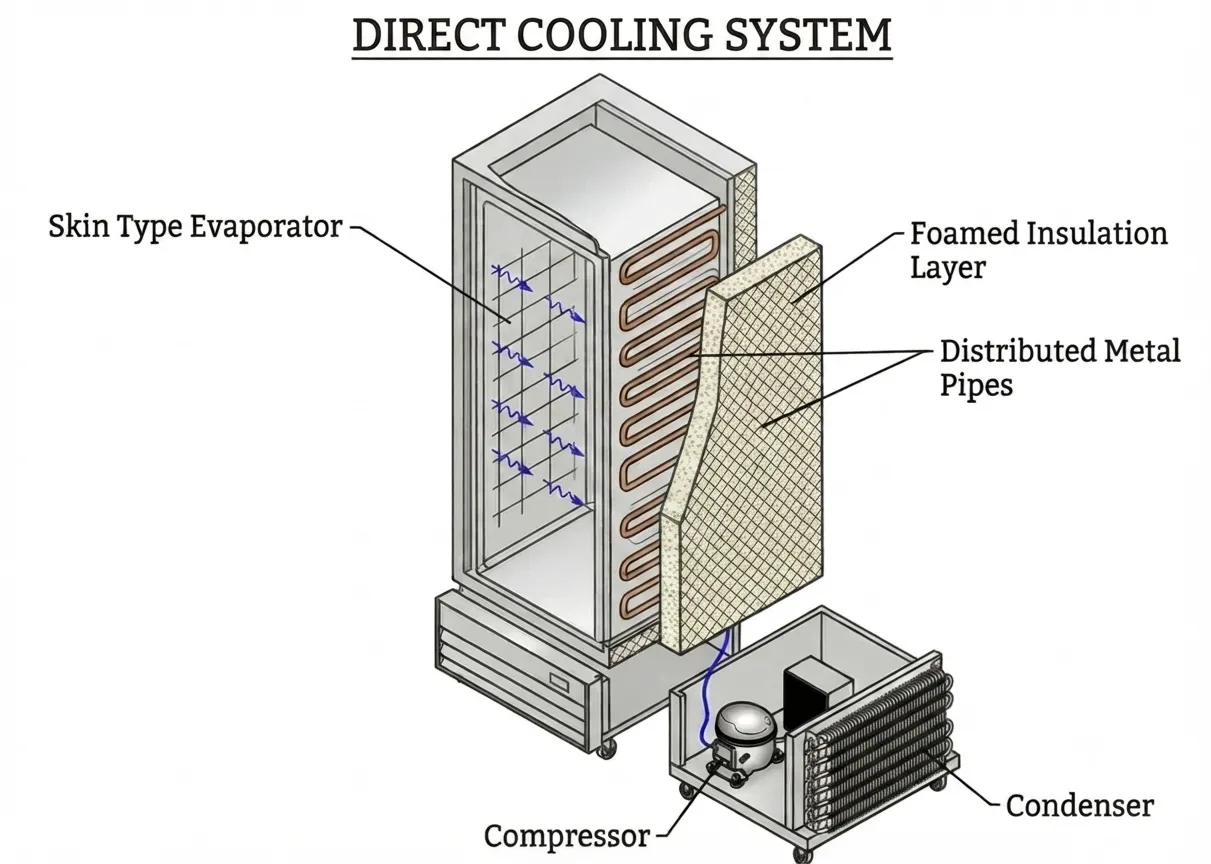
Direct cooling relies on natural convection. The evaporator coils sit inside the refrigerated space or behind a panel, and cold air sinks while warmer air rises, creating a slow circulation without any fans.
Because there is little air movement, different areas inside the cabinet may operate at slightly different temperatures. The bottom shelves are usually colder than the top shelves.
Direct cooling is commonly found in chest freezers, island freezers
, and refrigerators designed for fresh meat, seafood, or specialty foods where moisture retention is important.
Advantages of Direct Cooling
- Maintains higher humidity, helping reduce moisture loss from fresh products.
- Quiet operation because no internal circulation fan is required.
- Less energy due to its simple design.
- Less air movement helps prevent food from drying out.
- Lower initial equipment cost compared with more complex cooling systems.
Limitations
Direct cooling also has some practical limitations.
Temperature recovery is slower after the door or lid is opened. Cabinets may develop noticeable temperature differences between shelves, especially in taller upright models. Frost can gradually build up on the evaporator, so manual defrosting is often required unless an automatic defrost system is included.
What Is Dynamic Cooling (Forced Air Cooling, Frost-Free)?
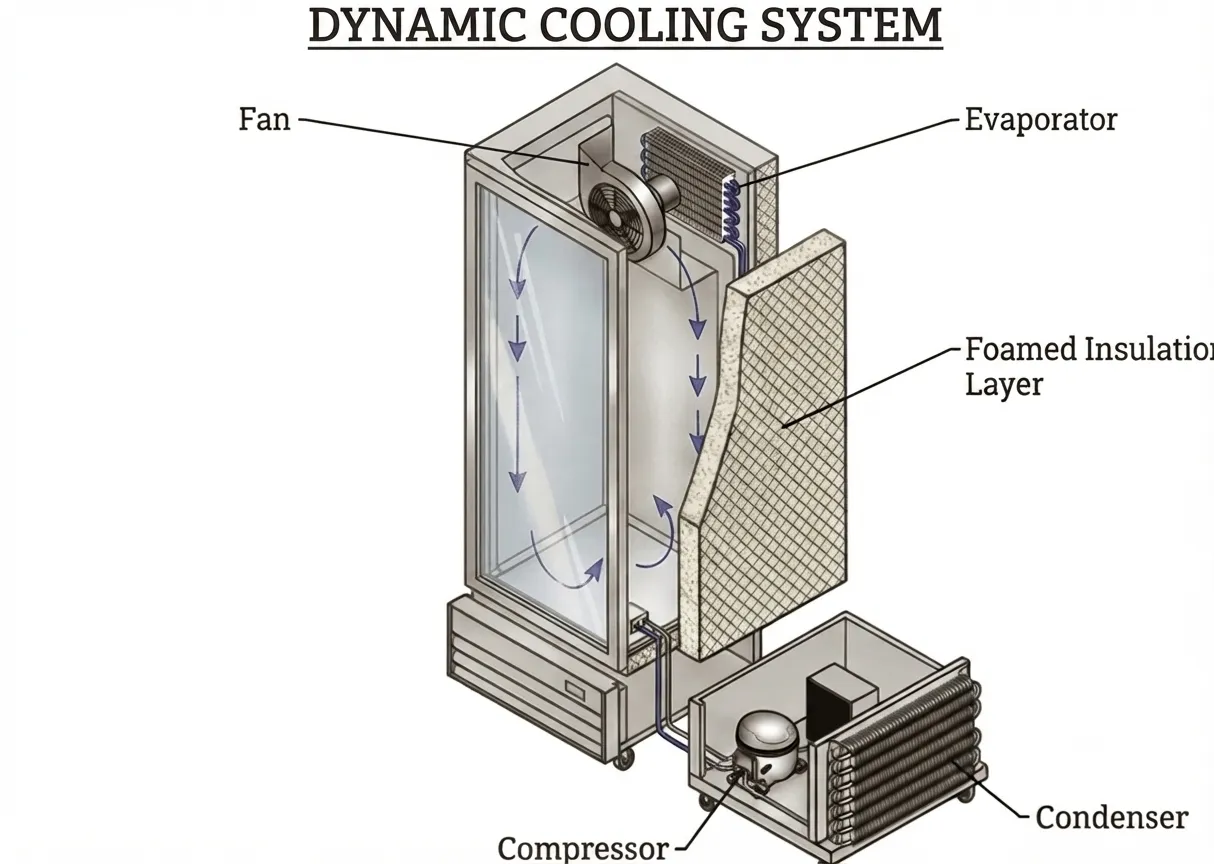
Dynamic cooling, also known as forced air cooling, frost-free cooling, uses one or more fans to continuously circulate cold air throughout the cabinet. The evaporator cools the air, and the fan distributes it evenly to every shelf.
This design creates a much more uniform temperature than direct cooling. Whether products are stored on the top shelf or near the bottom, the temperature difference is usually small.
You’ll find this in most beverage coolers, supermarket display refrigerators, convenience store merchandisers, bakery display cabinets, and commercial reach-in refrigerators
.
Advantages of Dynamic Cooling
- More even temperature throughout the cabinet.
- Rapid temperature recovery after frequent door openings.
- Faster cooling of newly loaded products.
- Better performance in busy retail environments with frequent customer access.
- Automatic defrost systems are commonly integrated, reducing manual maintenance.
Limitations
Continuous air circulation can gradually remove moisture from uncovered food.
The circulation fans also consume additional electricity and produce a small amount of operating noise.
Compared to direct cooling equipments, circulating fans have more components, resulting in higher costs and greater maintenance requirements.
More energy cost.
What Is Fan-Assisted Cooling?
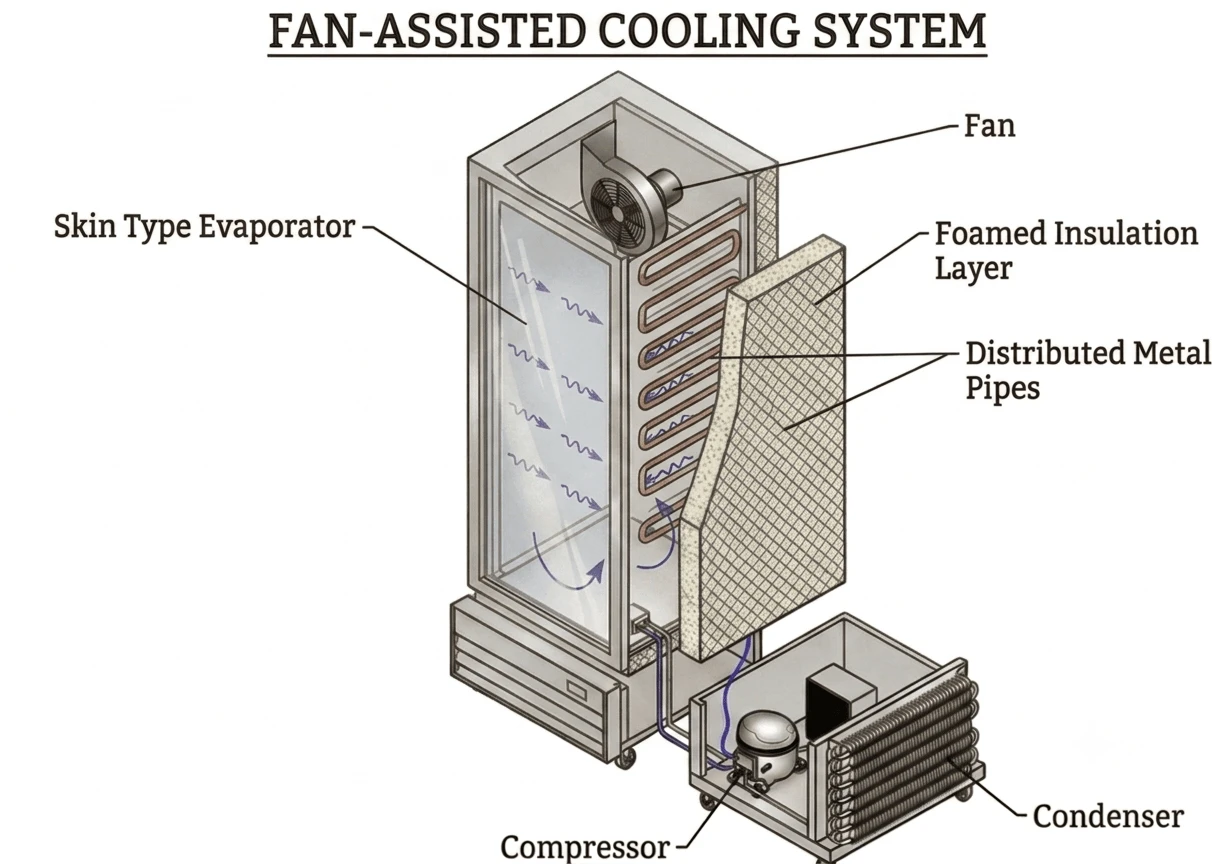
Fan assisted cooling sits between the two. It usually has a small fan or fans that run intermittently or at low speed to help the natural convection without turning the system into full forced air.
Many modern upright display cabinets and some reach-ins use this design. The fans might only kick in during recovery periods or when the thermostat calls for extra help.
Advantages of Fan-Assisted Cooling
- Better temperature uniformity than direct cooling.
- Less noise and energy use.
- Gentler airflow reduces moisture loss compared with full forced air systems.
- More stable product temperatures after the door is opened.
- Suitable for products that require attractive presentation without excessive drying.
- Provides a good balance between cooling performance and food preservation.
Limitations
Fan-assisted systems are more complex than direct cooling and usually cost slightly more. Temperature uniformity is improved but still may not match a fully forced air design in high-demand environments.
What Are the Main Differences?
| Feature | Direct Cooling | Fan-Assisted Cooling | Dynamic Cooling |
|---|---|---|---|
| Air circulation | Natural convection | Gentle fan circulation | Continuous fan circulation |
| Temperature uniformity | Moderate | Good | Excellent |
| Cooling speed | Slow | Medium | Fast |
| Temperature recovery | Slow | Good | Excellent |
| Humidity retention | Excellent | Good | Moderate |
| Risk of food drying | Very low | Low | Higher |
| Frost formation | More likely | Moderate | Usually automatic defrost |
| Noise | Very low | Lowe | Higher |
| Energy cost | Very low | Lowe | Higher |
| Purchasing price | Very low | Low | Higher |
Choosing the Most Suitable Solution
The best cooling system depends on what the cabinet is expected to store.
If the priority is preserving moisture in fresh food, direct cooling remains an excellent choice. Many butcher shops and seafood retailers prefer it because reduced airflow helps keep products looking fresh for longer.
If products need to be displayed attractively while maintaining stable temperatures, fan-assisted cooling offers a practical compromise. It provides more even cooling without exposing delicate foods to strong airflow.
For busy retail environments where doors are opened frequently and products are constantly restocked, dynamic cooling is generally the preferred solution. Beverage refrigerators, convenience stores, supermarkets, and commercial kitchens benefit from faster cooling, quicker temperature recovery, and consistent performance throughout the cabinet.
On export projects, we always look at local power reliability, ambient conditions, and how the end user will actually operate the equipment. A fancy forced air system on unstable voltage in a remote location can become a headache fast. Match the cooling type to real usage patterns and you avoid most problems.